







Equipment Used in Tablet Manufacturing:
The Full Line, Stage by Stage
From weighing and granulation to compression, coating, and packaging — the machines behind every tablet, and what matters when you buy them used.
What Equipment Is Used to Make Tablets?
A tablet line is a chain of machines, each preparing the powder for the next step: dispensing scales, granulators, dryers, mills, blenders, a tablet press, and a coating pan. Miss one link and the line does not run. This guide to the equipment used in tablet manufacturing walks that chain in production order — for the wider picture beyond tablets, see our overview of machines used in the pharmaceutical industry.
Every machine used in tablet manufacturing on this list is equipment we regularly buy and sell on the secondary market, so for each stage we also note what to look at before you commit to a used unit.
The Tablet Manufacturing Process, Machine by Machine
1. Weighing and Dispensing
Production starts with dispensing booths, floor scales, and balances that weigh out the active ingredient and excipients against the batch record. The active itself comes from an upstream plant — reactors, crystallizers, and dryers are the core equipment used in API manufacturing — and arrives at the tablet line as a powder to be verified, not made.
Used dispensing equipment is inexpensive, but insist on valid calibration certificates: a scale that cannot be calibrated to your accuracy class is scrap regardless of price.
2. Granulation
Most formulations flow too poorly to compress directly, so powders are granulated first. High shear granulators work a liquid binder into the powder with an impeller and chopper in a matter of minutes; fluid bed granulators spray binder onto powder suspended in warm air, granulating and drying in a single bowl. Dry granulation with roller compactors covers moisture-sensitive products.
On used granulators, check the bowl and impeller for pitting, confirm the spray system is complete, and ask for the change-parts list — a missing bowl often costs more to remake than the machine saved you.
3. Drying
Wet granules from a high shear granulator must be dried to a target moisture level, usually in a fluid bed dryer or, for heat-sensitive products, a vacuum tray dryer. Moisture out of range shows up later as capping and sticking problems at the press, so this stage is checked batch by batch.
When inspecting a used dryer, look at the filter bags or cartridges, door seals, and heating coils, and verify the explosion-relief arrangement matches your solvent and dust class — retrofitting one is far more expensive than buying a machine that already has it.
4. Milling and Sizing
Dried granules pass through a cone mill or oscillating granulator that breaks lumps and brings the particle size into a uniform band. Consistent granule size is what keeps tablet weight consistent at the press, so this small machine has an outsized effect on quality. On used mills, check screen condition and look for scoring on product-contact surfaces.
5. Final Blending
The sized granules go into a bin, V-type, or double cone blender, where extragranular excipients and the lubricant are folded in. Over-blending the lubricant is a classic cause of soft tablets, so a blender with reliable speed and timer control matters more than raw capacity. Browse our used industrial mixers and blenders for pharma-grade stainless units.
Look for polished 316L contact parts, intact documentation, and a shell free of dents — a dented body changes the tumbling action more than most buyers expect.
6. Tablet Compression
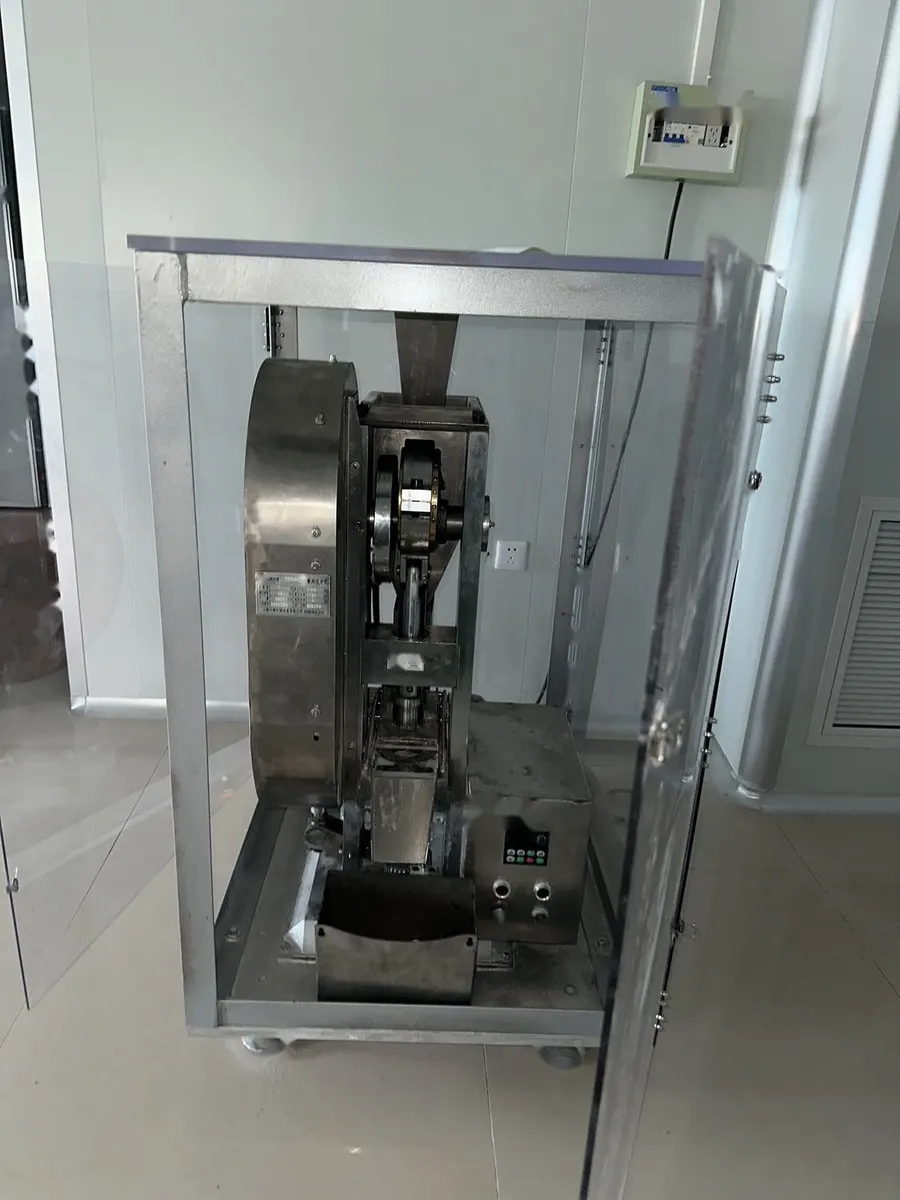
The tablet press is the heart of the line: it fills a die with granulate, compresses it between an upper and lower punch, and ejects a finished tablet. Rotary presses carry dozens of punch stations on a turret and reach outputs from tens of thousands to over a million tablets per hour. See our current stock of used granulators and tablet presses.
A single punch tablet making machine, by contrast, has one die and one pair of punches — the right choice for R&D, small batches, and specialty products. For a used press of either type, turn the turret or flywheel by hand to feel for roughness, check punch guides and cam tracks for wear, and confirm the tooling standard (B or D) matches your tablet sizes.
7. Tablet Coating
Coating protects the tablet, masks taste, and controls release. The main equipment used in tablet coating is the perforated coating pan: a rotating drum tumbles the tablets while spray guns apply the coating solution and hot air dries each layer. Fluid bed coaters handle pellets and smaller particles.
On a used coating pan, the spray guns, peristaltic pumps, and exhaust-air handling are what fail first — test the full spray system under pressure, not just the drum rotation.
8. Inspection and Packaging
Finished tablets pass through a deduster and metal detector, while hardness, thickness, and friability testers sample each batch before blister packing or bottle filling lines take over. Packaging machinery is a market of its own, but no tablet operation is complete without it — budget for it from the start rather than as an afterthought.
Buying Used Tablet Manufacturing Equipment: A Short Checklist
Whether you need one machine or a full line, the same checks apply to most equipment used for tablet manufacturing on the secondary market:
- Documentation — ask for the original manuals, drawings, and any IQ/OQ validation records.
- Contact parts — confirm 316L stainless steel wherever the product touches, free of pitting and re-welds.
- Change parts and tooling — bowls, screens, punches, and dies often cost more to replace than buyers budget for.
- Power-on test — insist on seeing the machine run, even unloaded, before shipment.
- Cleanability — check the machine can be stripped, cleaned, and documented to current GMP expectations.
A line assembled this way typically lands at a fraction of the new-equipment price and ships months sooner — the savings are real as long as the inspection is.
Sourcing Used Tablet Manufacturing Equipment
SIGMA Process Equipment stocks used granulators, fluid bed dryers, blenders, tablet presses, and coating pans, inspected and ready to ship worldwide. Alongside production machines we also handle used pharmacy compounding equipment and lab-scale units for pilot work — browse the full range of used pharmaceutical equipment to see what is in stock now.
Request a quote with your product, batch size, and target output, and we'll match the stages you need to machines in current stock.
FAQ — Equipment Used in Tablet Manufacturing
Building or Expanding a Tablet Line?
Tell us your product, batch size, and target output — we'll match granulators, dryers, blenders, tablet presses, and coating pans from current stock.
Request a Quote