







Water-to-Water Heat Exchangers:
Industrial Selection Guide
Plate vs shell and tube, the parameters that drive sizing, and what to inspect before buying used — a practical guide for process cooling water, waste heat recovery, and steam-to-hot-water systems.
What a Water-to-Water Heat Exchanger Does
A water to water heat exchanger transfers heat between two water circuits without letting them mix. One circuit gives up heat through a thin metal wall — plates or tubes — and the other carries it away. In a chemical plant that might be a cooling water heat exchanger pulling heat out of a closed process loop and rejecting it to a cooling tower circuit, or a unit recovering heat from hot condensate and returning it to boiler feedwater. Because the two streams stay separated, a treated or contaminated circuit can exchange heat with a clean one safely. Browse our full range of used heat exchangers and condensers to see the hardware behind these duties.
The same hardware shows up under different names depending on the duty. A chilled water heat exchanger isolates a chiller loop from process equipment; a waste water heat recovery unit captures heat from warm effluent before it goes to drain; a jacket-water cooler keeps engine or compressor cooling loops at temperature. Mechanically they all come down to the same two equipment families, which is where selection starts.
Plate vs Shell and Tube: The Two Main Types
Plate Heat Exchangers
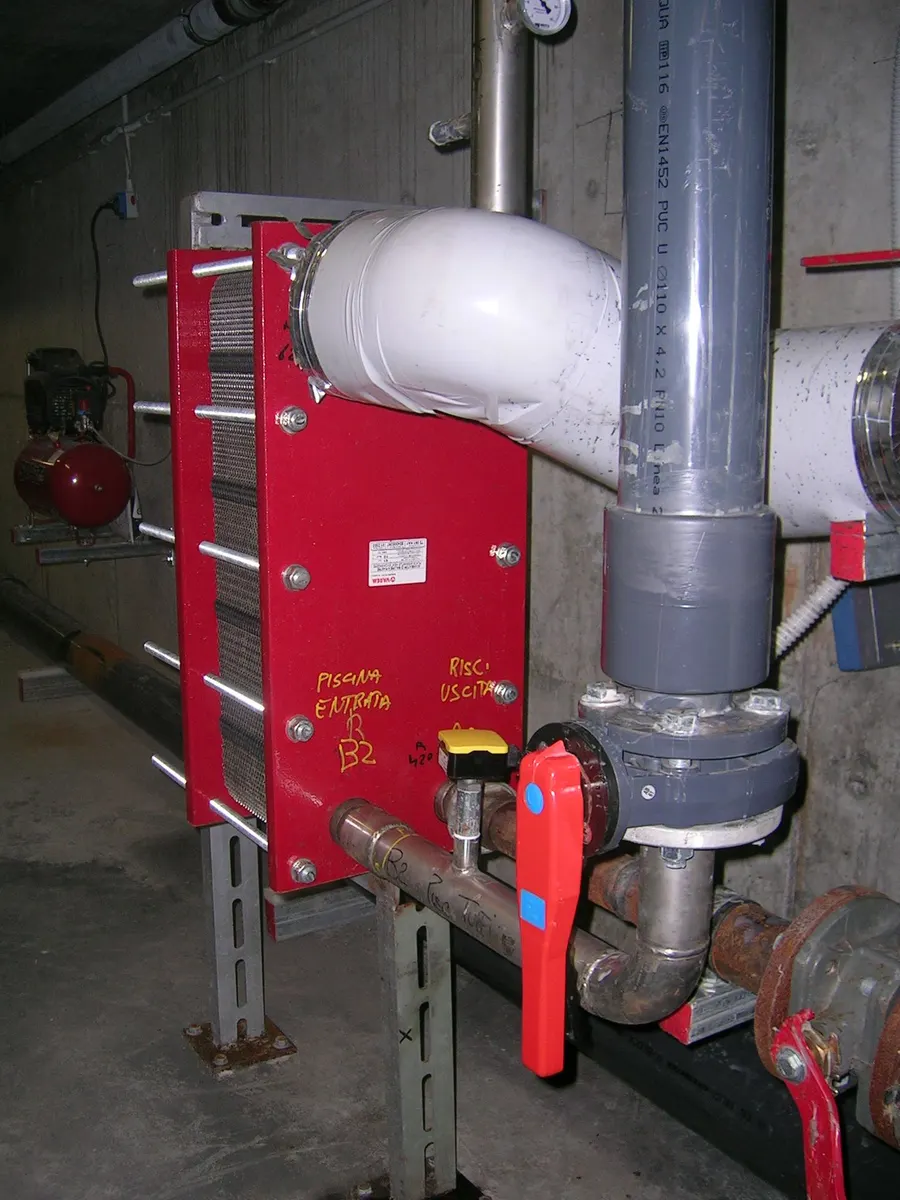
A plate heat exchanger stacks thin corrugated plates in a frame, creating alternating channels for the hot and cold streams. The corrugations force turbulent flow, so plate units reach very high heat transfer rates in a compact footprint and can run a close temperature approach — down to 1–2 °C between circuits. That makes them the default for water-to-water duties where both streams are clean: chiller isolation, cooling tower isolation, and process hot water loops. See our current stock of used plate heat exchangers.
Gasketed plate units are also easy to service: the frame opens for cleaning, and capacity can be adjusted by adding or removing plates. The trade-off is pressure and temperature limits set by the gaskets, and sensitivity to particulates that can clog the narrow channels.
Shell and Tube Heat Exchangers
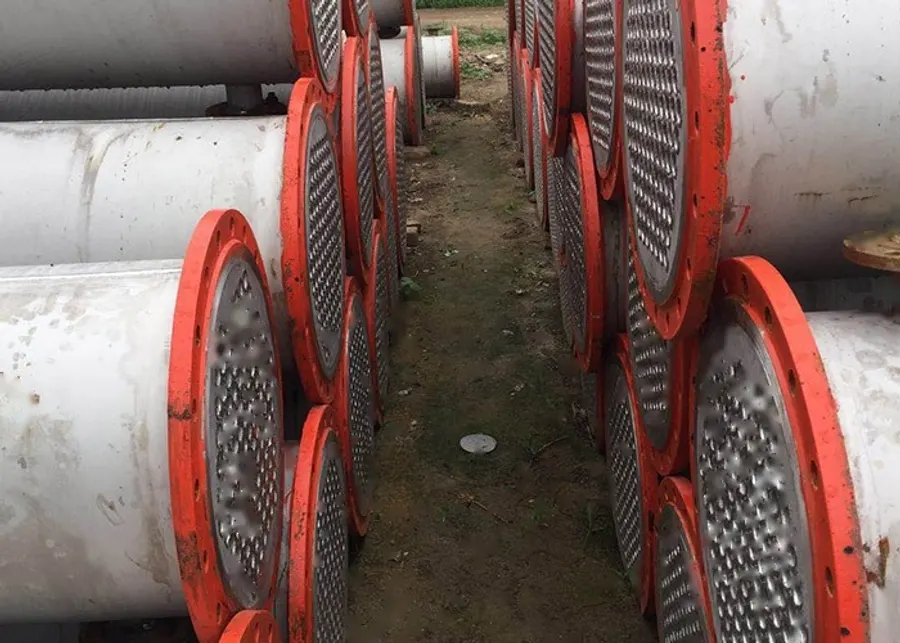
A shell and tube unit runs one stream through a bundle of tubes while the other flows around them inside a pressure shell. It tolerates higher pressures and temperatures, handles dirty or particulate-laden water far better, and is the standard choice for steam heating and condensing duties. Tube bundles can be pulled for mechanical cleaning, which matters when one circuit is river water, effluent, or an open cooling loop. Browse used shell and tube heat exchangers in stock.
The cost is size: for the same duty, a shell and tube exchanger is larger and needs a wider temperature approach, typically 5–10 °C. In practice, plants pick plate for clean, close-approach water-to-water service and shell and tube for steam, fouling, or high-pressure service.
For a deeper side-by-side on cost, fouling, maintenance, and footprint, read our plate vs shell and tube comparison.
Where Air-to-Water Units Fit
An air to water heat exchanger moves heat between an air stream and a water circuit instead of between two liquids — a finned coil with a fan, or a larger coil bank in a duct. In industrial plants they appear as dry coolers rejecting process heat to ambient air, and as heat recovery coils capturing heat from hot exhaust air into a water loop. If your heat source or sink is air, that is the equipment class to look at; everything else in this guide assumes liquid on both sides.
Integrating With Hot Water Systems
In steam plants, hot water heat exchangers are the bridge between the boiler and low-temperature consumers. A steam to hot water heat exchanger — usually a compact shell and tube or a plate unit rated for the steam pressure — generates process hot water or washdown water on demand, with the condensate returned to the boiler. Non-critical loads can then run on the water loop instead of live steam, which simplifies piping and control.
Where demand is intermittent, pairing the exchanger with a hot water heat exchanger tank — a buffer or storage vessel on the secondary side — lets a smaller unit cover peak draw. The exchanger charges the tank during low demand, and the tank rides through the peaks.
Selection Parameters That Actually Matter
Sizing starts with the temperature program — inlet and outlet temperatures on both circuits — and the flow rate on each side. Together these fix the duty in kW and the mean temperature difference driving the transfer. A close approach between circuits pushes you toward a plate unit; a large temperature difference or a steam side points to shell and tube. State a fouling margin explicitly: a water to water heat exchanger sized with no margin will run undersized within months on an open cooling loop.
Materials follow the water quality. Stainless steel 316 plates or tubes handle most treated cooling and hot water. Chlorides — seawater, brackish well water, some effluents — call for titanium plates or higher alloys. On plate units the gasket material (NBR, EPDM, Viton) is picked for temperature and chemistry. Finally, check pressure ratings against both circuits, including transient spikes from pump starts.
Buying Used: What to Inspect
Heat exchangers are a low-risk category to buy used — no moving parts, and condition can be verified directly. On used units we check and document:
- Pressure test on both circuits — verifies plate or tube integrity with no cross-leakage between streams.
- Plate and gasket condition — plate units are opened, plates inspected for corrosion or deformation, and gaskets replaced where needed.
- Tube bundle condition — visual and, where warranted, eddy-current inspection of shell and tube bundles for thinning or pitting.
- Nameplate data and drawings — design pressure, temperature, heat transfer area, and material certificates, so you can match the unit to your duty.
- Fouling and cleanliness — channels and tubes cleaned, with heat transfer surfaces inspected before dispatch.
SIGMA Process Equipment stocks used plate and shell and tube heat exchangers, pressure-tested and ready to ship. Request a quote with your temperature program, flow rates, and water quality — we'll match a unit from current inventory.
FAQ — Water-to-Water Heat Exchangers
Need a Used Heat Exchanger for Your Process?
Tell us your temperature program, flow rates, and water quality — we'll match you to a pressure-tested plate or shell and tube unit from current stock.
Request a Quote